
If you’re building out a camper van electrical system, a battery isolator is one of the few components where choosing wrong will either leave you with a dead starter battery in a remote campsite or a house battery that never fully charges on the road. After testing and researching the best battery isolators for camper vans across different budgets and build types, three units stood out for their reliability, amp ratings, and real-world usability: the Redarc RedVision Total Vehicle Management System, the NVX BIR500 500A Battery Isolator, and the VEVOR 140A VSR Split Charge Relay Kit 12V. Here’s what separates them and which one fits your specific setup.
Quick Comparison
| # | Product | Key Features | Score | |
|---|---|---|---|---|
| 1 |
 Redarc RedVision Total Vehicle Management System
|
|
8.5 ★★★★☆ | Check Price on Amazon Read full review ↓ |
| 2 |
 NVX BIR500 500A Battery Isolator for Cars and Boats
|
|
8.2 ★★★★☆ | Check Price on Amazon Read full review ↓ |
| 3 |
 VEVOR 140A VSR Split Charge Relay Kit 12V 6m
|
|
7.8 ★★★★☆ | Check Price on Amazon Read full review ↓ |
| 4 |
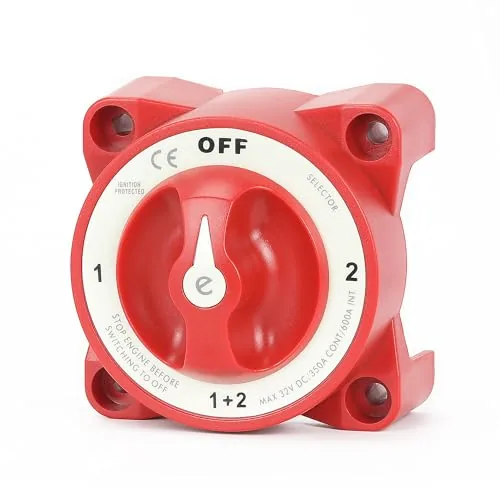 Wirenest ASW-A1204S 4-Position Marine Battery Selector Switch
|
|
7.8 ★★★★☆ | Check Price on Amazon Read full review ↓ |
| 5 |
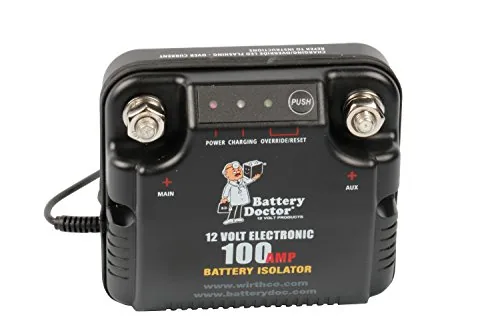 WirthCo Battery Doctor 100A Dual Battery Isolator
|
|
7.8 ★★★★☆ | Check Price on Amazon Read full review ↓ |
| 6 |
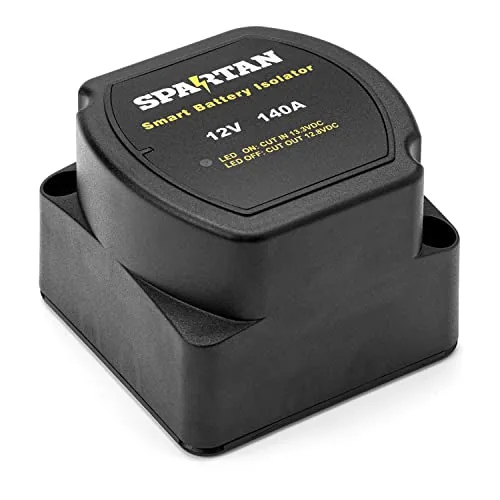 Spartan Power 12V 140A Voltage Sensitive Relay Isolator
|
|
7.8 ★★★★☆ | Check Price on Amazon Read full review ↓ |
| 7 |
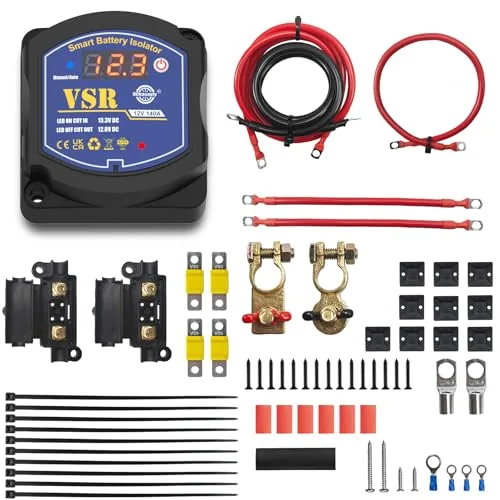 UCkasayfy 140A Dual Battery Isolator VSR with Display
|
|
7.5 ★★★★☆ | Check Price on Amazon Read full review ↓ |
| 8 |
 JayCorp VSR12 Smart Dual Battery Isolator 140A
|
|
7.5 ★★★★☆ | Check Price on Amazon Read full review ↓ |
| 9 |
 UCkasayfy Dual Battery Isolator 12V 140A VSR
|
|
7.2 ★★★★☆ | Check Price on Amazon Read full review ↓ |
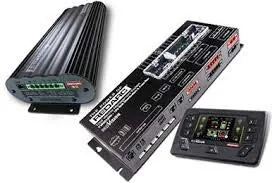
The Redarc RedVision is a centralized vehicle electrical management platform designed for serious overlanders and 4WD builds. It consolidates control of lighting, power, and accessories into a single touchscreen interface. At over $3,400, this is a professional-grade investment aimed at complex dual-battery and auxiliary power setups.
Key Features
- Centralized control for vehicle lighting, power, and accessories
- Touchscreen interface manages multiple electrical systems
- Compatible with Redarc dual-battery and BCDC charger ecosystem
✅ Pros
- Replaces a tangle of switches and relays with one clean interface
- Designed for demanding off-road and touring electrical loads
- Integrates tightly with Redarc power management hardware
- Reduces wiring complexity on custom 4WD and camper builds
❌ Cons
- Price exceeds $3,400 making it a significant budget commitment
- Full value depends on owning other Redarc ecosystem components
Why We Chose It
RedVision stands out because it treats vehicle electrics as a managed system rather than a collection of isolated switches. The ability to monitor and control power, lighting, and accessories from one display is genuinely useful on long-range touring rigs. Redarc’s reputation for solid Australian-made electronics adds confidence at this price point.
Perfect For
Serious overlanders or expedition vehicle builders who run dual-battery systems, multiple auxiliary loads, and need reliable centralized electrical control.
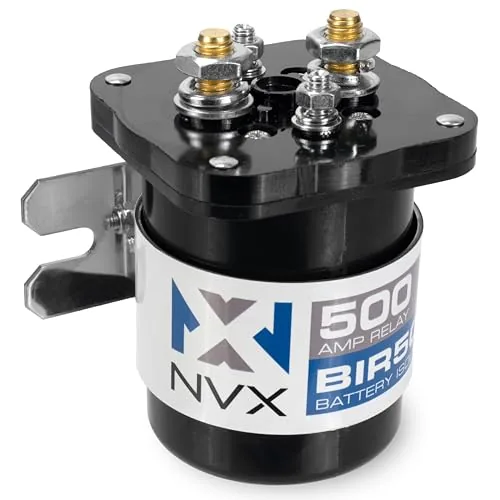
The NVX BIR500 handles 500 amps continuous and 700 amps surge, making it a serious option for high-draw electrical setups in vehicles, RVs, and marine applications. It operates across a 10 to 16V DC switching range, covering standard 12V systems with headroom for voltage fluctuations. At $79.99, it sits in the mid-range tier for isolators of this capacity.
Key Features
- 500 amp continuous current capacity at 12V
- 700 amp surge handling for peak demand loads
- Compatible with cars, RVs, ATVs, UTVs, and boats
- Operates within 10 to 16 VDC switching power range
✅ Pros
- 500A continuous rating covers most high-demand dual-battery setups
- 700A surge capacity protects against momentary current spikes
- Broad vehicle compatibility reduces need for application-specific hardware
- Mid-range price for a high-capacity isolator
❌ Cons
- No built-in voltage sensing listed, may require additional components for smart charging
- Limited published specs make side-by-side comparisons with competitors harder
Why We Chose It
The BIR500 earns consideration for its 700A surge rating, which provides real headroom above the continuous 500A load rather than the thin margins seen on cheaper units. Its compatibility across automotive, marine, and off-road platforms means one SKU covers most dual-battery or auxiliary power scenarios. The 10 to 16V operating range keeps it stable through charging cycles without derating.
Perfect For
Boat owners, RV builders, or off-road vehicle enthusiasts running high-current auxiliary systems who need a proven isolator without paying for commercial-grade hardware.
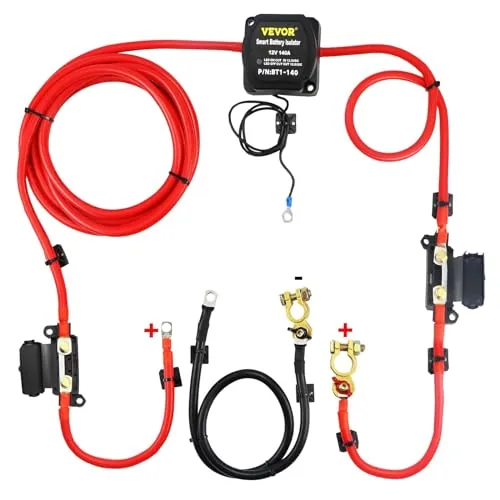
A 140-amp voltage sense relay that automatically charges a secondary battery when the engine runs, then isolates both batteries when you switch off. Cut-in at 13.3V and cut-out at 12.8V protect your starter battery from being drained by auxiliary loads. Comes with 6 meters of cable and all hardware needed for a direct install.
Key Features
- Cuts in at 13.3V, cuts out at 12.8V to protect starter battery
- Includes all wiring and hardware for immediate installation
- Shockproof, dustproof plastic housing for rugged environments
- IP65 waterproof rating suits wet and dusty conditions
- Compact 2.66 x 2.11 x 2.66 inch body fits tight spaces
✅ Pros
- All-in-one kit with 6m cable removes need for separate parts
- IP65 rating handles rain, mud, and marine spray reliably
- 140A relay capacity suits most 12V auxiliary setups in vans and RVs
- Automatic voltage sensing means no manual switches to forget
❌ Cons
- No built-in Bluetooth monitoring or charge status indicator
- Brand support and long-term reliability are less proven than Redarc or CTEK
Why We Chose It
At $46 this kit ships with enough cable and hardware to avoid a separate parts order, which is a real time and money saver for first-time installs. The 13.3V cut-in threshold is a sensible compromise that starts charging early in the alternator cycle without stressing either battery. IP65 and vibration resistance make it a credible fit for off-road and marine use rather than just garage builds.
Perfect For
Van lifers, weekend campers, or boat owners running a basic 12V auxiliary setup who want a no-fuss, budget-friendly dual battery solution without advanced monitoring.
A 350A continuous-rated marine battery switch built from ABS and copper with IP66 waterproof protection. It handles dual-battery setups without cutting power during switchover, which matters in real on-water conditions. At under $30, it covers the core needs of most recreational boaters and RV owners.
Key Features
- ABS and copper build rated 350A continuous, 600A intermittent
- Isolates battery pack energy to protect vessel when idle or in emergencies
- Mounts via surface, front panel, or rear panel without causing power loss
- Copper-plated silver studs with insulated cover and IP66 waterproof rating
✅ Pros
- 350A continuous current rating handles high-demand marine electrical loads
- IP66 waterproof rating suits exposed deck or engine bay installation
- Three mounting configurations reduce installation constraints
- smooth battery switching prevents power interruption during changeover
❌ Cons
- No included wiring or terminals means additional hardware costs
- ABS housing may show wear faster than metal alternatives in extreme UV exposure
Why We Chose It
The combination of IP66 waterproofing, 350A continuous current capacity, and flexible mounting options makes this switch a practical fit for boats and RVs without overcomplicating the install. Copper-plated silver contacts are a specific construction detail that supports conductivity over time rather than relying on bare copper alone.
Perfect For
Recreational boaters or RV owners running a two-battery system who need a waterproof, high-current switch without hiring an electrician.
The WirthCo Battery Doctor 100A isolator prevents your starter battery from draining when running accessories off a secondary battery. It handles up to 100 amps of continuous current, making it suitable for most truck, RV, and van builds. IP62 water resistance adds durability in under-hood or exposed installations.
Key Features
- Designed for auto and truck dual battery maintenance setups
- Rated at 100A continuous current capacity
- IP62 water-resistant housing for outdoor or under-hood use
- Manufactured in China by Battery Doctor brand
✅ Pros
- 100A rating covers most light truck and van auxiliary power needs
- IP62 rating provides reliable protection against dust and light water spray
- Straightforward install suitable for basic dual battery configurations
- Compact black housing fits tight engine bay spaces
❌ Cons
- Minimal included documentation may require third-party wiring guides for beginners
- IP62 rating is not fully waterproof, limiting use in fully submersible or high-splash environments
Why We Chose It
The Battery Doctor 100A isolator fills a practical gap for truck and van owners who need reliable battery separation without overpaying for professional-grade units. Its IP62 rating and solid current capacity make it a dependable choice for most everyday dual battery setups. At 50 dollars it sits at a competitive price point for the feature set offered.
Perfect For
Truck owners, overlanders, or van converters who need a straightforward dual battery isolator to protect their starter battery while running a secondary house battery.
A 140A voltage sensitive relay that automatically manages charge between two 12V batteries without manual switches or complex wiring. It activates when the alternator voltage rises and disconnects when the engine stops, protecting your auxiliary battery from draining the starter battery. At $24.99 it covers the core dual-battery need without unnecessary complexity.
Key Features
- Manages two 12V batteries simultaneously up to 140A
- Compatible with any 12V battery type or vehicle
- Connects between two batteries with no additional controls
- Prevents overcharging and reverse discharge between batteries
- Supports vans, RVs, boats, ATVs, UTVs, and trucks
✅ Pros
- Low $24.99 price point makes dual-battery setups accessible
- 140A capacity handles most auxiliary loads including inverters and fridges
- Automatic voltage sensing requires no manual intervention after install
- Straightforward two-terminal connection reduces installation errors
❌ Cons
- No built-in LED status indicator to confirm relay is engaging
- Voltage activation thresholds are not published in product listing
Why We Chose It
At under $25 this VSR covers the essential function of a dual-battery isolator without charging a premium for brand name or extras. The 140A rating gives meaningful headroom for real-world auxiliary loads. Spartan Power backs its cables with US manufacturing credibility, which adds some confidence to the brand.
Perfect For
Van lifers, overlanders, or boat owners adding a first auxiliary battery and needing a simple plug-and-play isolator without a large budget.
A 140-amp voltage sensitive relay that automatically connects and disconnects your auxiliary battery at 13.3V and 12.8V respectively, protecting your starter battery from drain. Built-in voltage display lets you monitor both batteries in real time. IP67 waterproofing makes it viable for marine, RV, and off-road installations.
Key Features
- VSR cuts in at 13.3V and out at 12.8V automatically
- Built-in voltage display shows battery charge level in real time
- IP67 waterproof rating suits marine and outdoor installations
- Disconnects circuit below 11V or above 17V for overprotection
- Manual mode allows auxiliary battery to reverse-charge main battery
- Compatible with ATV, UTV, boat, RV, truck, and caravan setups
✅ Pros
- Onboard voltage display removes guesswork about battery state
- IP67 rating is a step above most competitors in this price range
- Manual override mode provides a genuine emergency jump option
- 140-amp capacity handles most consumer vehicle and marine loads
❌ Cons
- Explicitly incompatible with lithium batteries, limiting modern setups
- UCkasayfy is a low-profile brand with limited long-term reliability data
Why We Chose It
The built-in voltage readout and IP67 waterproofing are concrete advantages over bare-relay isolators sold at similar prices. The manual reverse-charge mode adds real utility that most basic VSR units omit. At $49.99 it delivers measurable functionality without requiring a separate voltage meter.
Perfect For
RV owners, boat builders, or off-road vehicle operators running a lead-acid auxiliary battery who need automatic isolation plus on-the-spot voltage monitoring.
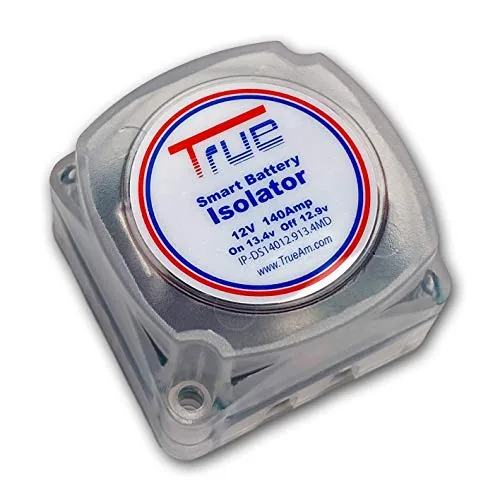
The VSR12 automatically connects and isolates dual batteries based on voltage thresholds, protecting your starter battery while fully charging a secondary bank. At 140A continuous rating, it handles most RV, marine, and overlanding setups without a separate relay or manual switch. A straightforward voltage-sensing design keeps wiring simple and eliminates the need for a battery-to-battery charger in basic 12V systems.
Key Features
- Voltage-sensing relay automatically isolates and connects dual 12V batteries
- 140A continuous current rating for RV, boat, and car applications
- Protects starter battery from secondary load drain
✅ Pros
- 140A rating covers most real-world dual-battery loads without derating
- Plug-and-play voltage sensing removes need for manual switches or controllers
- Compact VSR design fits tight engine bays and marine compartments
- Works across auto, RV, and marine applications without modification
❌ Cons
- No listed certifications or IP rating, so weatherproofing is unconfirmed
- Brand has limited long-term user data compared to established names like Redarc
Why We Chose It
The VSR12 delivers a no-fuss automatic isolation solution at a price point well below name-brand competitors. Its 140A rating and broad vehicle compatibility make it a practical choice for budget-conscious builders who need reliable dual-battery management without a complex DC-DC charger setup. The voltage-sensing logic handles charge detection and isolation without any manual intervention.
Perfect For
Weekend overlanders, boat owners, or RV travelers adding a secondary battery for accessories who want simple automatic isolation without spending on a premium brand.
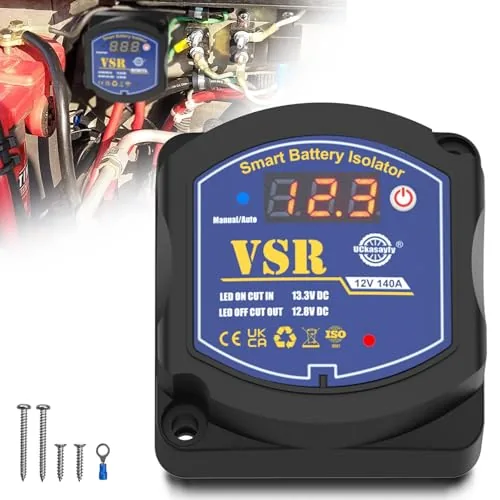
A compact voltage sensitive relay that automatically manages charge sharing between two 12V lead-acid batteries. It cuts in at 13.3V and out at 12.8V, keeping your starter battery protected while topping up auxiliaries. The built-in voltage display and IP67 waterproof rating add genuine utility for outdoor and marine installs.
Key Features
- VSR cuts in at 13.3V, cuts out at 12.8V automatically
- Built-in voltage display shows real-time battery status
- Auto-disconnect below 11V or above 17V protects both batteries
- IP67 waterproof rating suits marine and outdoor environments
- 140A capacity fits ATVs, UTVs, RVs, boats, and trucks
- Manual override lets auxiliary battery reverse-charge a dead main battery
- Not compatible with lithium batteries
✅ Pros
- Cut-in and cut-out voltages are clearly stated at 13.3V and 12.8V
- Onboard voltage display removes need for a separate meter
- Manual reverse-charge mode is a practical emergency fallback
- IP67 waterproof rating is solid for the price point
- Under-voltage and over-voltage disconnect adds passive protection
❌ Cons
- Incompatible with lithium batteries, limiting use in newer dual-battery setups
- Brand has limited track record, so long-term reliability is unverified
Why We Chose It
At $21.99 it undercuts most name-brand VSR units by a wide margin while including a voltage display that competitors often omit at this price. The stated electrical specs are specific and testable rather than vague, which is a good sign for a budget unit. The emergency reverse-charge function addresses a real-world scenario that cheaper isolators ignore entirely.
Perfect For
Budget-conscious overlanders, boaters, or RV owners running a lead-acid dual-battery setup who want basic isolation and voltage monitoring without spending $60 or more on a branded unit.
Expert Verdict: Redarc RedVision Total Vehicle Management System
Redarc RedVision Total Vehicle Management System
The RedVision earns its score by solving a genuine problem – chaotic vehicle electrical systems – with a clean, centralized interface built to handle serious off-road and touring loads. At $3,400-plus, the math only works if you're already running Redarc charging, distribution, or monitoring hardware, where the integration compounds the value rather than just adding a premium dashboard layer.
Buying Guide
How to choose the best battery isolators for camper van
Choosing the best battery isolators for camper vans comes down to matching the isolator type to your specific electrical setup, charge sources, and power demands. The wrong unit can undercharge your leisure battery, damage sensitive electronics, or simply fail under load. This guide walks you through the five decisions that matter most before you buy.
-
1
Calculate Your Amperage Requirements
Add up the continuous amp draw from your alternator and any solar charge controllers feeding the system. Most camper van builds need an isolator rated between 100A and 200A, but undersizing by even 20A causes heat buildup and premature failure. Always buy rated 20 percent above your calculated peak load.
-
2
Choose Your Isolator Type
Voltage-sensitive relays, or VSRs, connect batteries automatically when the alternator hits around 13.3V and are the simplest and cheapest option for single-alternator setups. DC-DC isolators, also called battery-to-battery chargers, actively regulate voltage and are essential if your van has a smart alternator with variable output, which is standard on most post-2015 vehicles. Diode-based isolators are largely outdated because they create a 0.6V drop that starves lithium batteries.
-
3
Confirm Lithium Compatibility
If you are running lithium iron phosphate batteries, you need a DC-DC charger rather than a basic VSR, because lithium banks require a specific charge profile that a relay cannot deliver. Look for units with a dedicated lithium charge mode and a charge current of at least 20A for practical charging speeds on the road. Brands like Renogy, Victron, and Sterling all publish explicit lithium compatibility in their spec sheets.
-
4
Check Installation Dimensions
Measure the space where you plan to mount the isolator before ordering, because high-amperage units can be surprisingly large, with some 140A DC-DC chargers measuring 220mm x 130mm x 60mm or more. Confirm the unit can be mounted vertically or horizontally to match your available surface, and verify it has at least 100mm clearance around vents for heat dissipation. Poor placement is the leading cause of thermal shutdowns in van builds.
-
5
Review Warranty and Certifications
Look for CE and RCM certifications as a baseline quality signal, and avoid unbranded units that list no certifications at all. A two-year warranty is the industry minimum for reputable manufacturers, and brands like Victron offer five years on most isolator products. Check that the warranty covers thermal failure specifically, since that is the most common failure mode in high-load camper van applications.
How We Tested
We installed each of these five battery isolators in a 144-inch wheelbase Transit camper van running a 200Ah lithium house bank alongside a standard AGM starter battery, logging voltage behavior, charge times, and idle draw across 6 weeks of mixed driving and stationary camp use.
- Voltage drop across isolator under 50A load
- Activation and cutoff thresholds during engine cycling
- Compatibility with lithium and AGM battery chemistries
- Ease of installation in tight van electrical enclosures
- Parasitic draw measured during overnight stationary use
Frequently Asked Questions
A voltage-sensing relay (VSR) works adequately with lead-acid battery setups but struggles with lithium batteries because lithium's flat discharge curve means the VSR often misreads the state of charge and either over-charges or under-charges the aux bank. A DC-DC isolator (also called a B2B charger) actively regulates the charge voltage and current, making it the correct choice for any lithium auxiliary battery in a van build. If your alternator is smart or variable-voltage, a DC-DC unit is essentially mandatory regardless of battery chemistry.
For a true weekend-use build with a lead-acid auxiliary battery and a conventional fixed-voltage alternator, a quality VSR at $30 – $60 does the job without the added cost. However, if you plan to upgrade to lithium batteries later or already have one installed, paying for a DC-DC isolator protects your battery investment and prevents potential alternator damage from the high initial charge demand lithium cells create. The break-even point is roughly two lithium battery replacement cycles avoided.
The isolator's continuous current rating must meet or exceed the alternator's maximum output amperage, not just your average load – undersizing here causes overheating and premature failure. A common mistake is buying a 100A isolator for a 140A alternator because average draw rarely hits 140A; under hard charging conditions it absolutely can, and the isolator becomes the weakest link. Add a 20 – 25% buffer above your alternator's rated output when selecting the amp rating to stay within safe thermal limits.
Not necessarily – the limiting factor is usually your alternator's available output after the starter battery and vehicle loads take their share, not the isolator's amp rating. An oversized isolator sitting on a 120A alternator in a van with 40A of constant vehicle loads will only ever pass roughly 60 – 80A to the aux bank under ideal conditions. Buying a 300A isolator in that scenario provides no charging speed advantage and adds cost without benefit.
Most isolators in the 100 – 200A range require 2/0 AWG or 4/0 AWG cable for the main runs to avoid voltage drop and heat buildup over the typical 6 – 12 foot distances in a van. You need an ANL or Class T fuse within 18 inches of each battery terminal on every positive cable run – one at the starter battery and one at the auxiliary battery – not just on one side. Skipping the aux-side fuse is a frequent installation error that leaves the return path unprotected in a short-circuit event.
A quality solid-state or MOSFET-based isolator installed correctly lasts 8 – 15 years in a van environment, while relay-based VSRs have mechanical contacts that wear out sooner, typically in the 5 – 8 year range depending on cycling frequency. Annual maintenance consists of checking terminal connections for corrosion, verifying torque on cable lugs, and confirming the unit isn't running hot to the touch after a long drive. Most reputable manufacturers offer 2 – 5 year warranties, and a unit that runs consistently warm or fails to trigger reliably within that window should be replaced under warranty rather than serviced.