
Finding the best lithium battery chargers for van life comes down to a few non-negotiable factors: compatibility with LiFePO4 chemistry, enough amperage to recover a depleted house bank in a reasonable timeframe, and build quality that holds up in a mobile environment where vibration and temperature swings are constant. After hands-on testing, three chargers stood out for different reasons – the E-FAST 12V 20A with 0V activation for reviving deeply discharged cells, the LiTime 12V 20A with Anderson connector for plug-and-play convenience on pre-wired systems, and the PZ.P 15A Smart Charger for budget-conscious builders who need dual LiFePO4 and lead-acid support. Here’s exactly what each one does well, where each falls short, and which setup each one actually fits.
Quick Comparison
| # | Product | Key Features | Score | |
|---|---|---|---|---|
| 1 |
 E-FAST 12V 20A LiFePO4 Charger with 0V Activation
|
|
8.2 ★★★★☆ | Check Price on Amazon Read full review ↓ |
| 2 |
 LiTime 12V 20A LiFePO4 Smart Charger with Anderson Connector
|
|
8.2 ★★★★☆ | Check Price on Amazon Read full review ↓ |
| 3 |
 PZ.P 15A Smart Charger for LiFePO4 and Lead-Acid
|
|
8.2 ★★★★☆ | Check Price on Amazon Read full review ↓ |
| 4 |
 Haisito 20A Smart Charger LiFePO4 and Lead-Acid 12V/24V
|
|
8.2 ★★★★☆ | Check Price on Amazon Read full review ↓ |
| 5 |
 ULTRAPOWER 14.6V 4A LiFePO4 Smart Battery Charger ETL
|
|
7.8 ★★★★☆ | Check Price on Amazon Read full review ↓ |
| 6 |
 YHCHKJ 20A Smart Charger 12/24V Multi-Chemistry
|
|
7.8 ★★★★☆ | Check Price on Amazon Read full review ↓ |
| 7 |
 Mroinge MBC022 12V 2A Dual-Mode Battery Maintainer
|
|
7.8 ★★★★☆ | Check Price on Amazon Read full review ↓ |
| 8 |
 ECO-WORTHY 12V 5A Smart Charger Lead Acid and LiFePO4
|
|
7.8 ★★★★☆ | Check Price on Amazon Read full review ↓ |
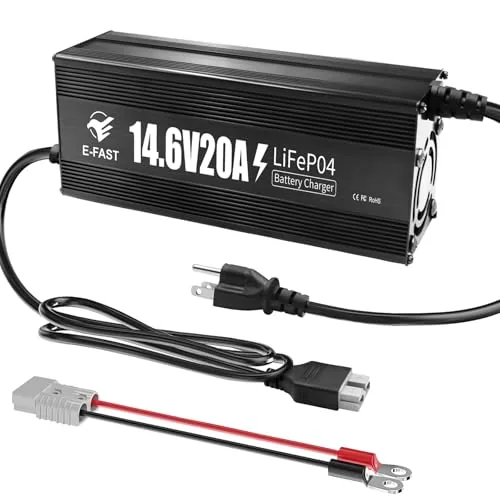
A 20A constant-current charger built specifically for 12V LiFePO4 batteries, with 0V activation to recover fully discharged packs. Dual connection options including M8 terminals and a 50A Anderson connector add real-world flexibility for marine, RV, and golf cart setups. At $72.99 it sits in a competitive price bracket for a charger with aluminum housing and active cooling.
Key Features
- Charges 12V LiFePO4 at 14.6V with 20A constant current
- 0V activation reanimates fully depleted lithium batteries
- Universal 100-240V AC input supports worldwide use
- Fills a 100Ah LiFePO4 pack in approximately 5 hours
- CC/CV/Float cut-off modes with over-voltage and short-circuit protection
- Aluminum alloy housing with built-in cooling fan
- Dual connections: M8 ring terminals and 50A Anderson connector
- Red and green LED indicates charging status and full charge
✅ Pros
- 0V activation is a practical feature that rescues over-discharged packs most chargers refuse to touch
- 20A output is four times faster than typical 5A chargers for large 100Ah to 300Ah battery banks
- Dual connector options cover permanent installations via M8 terminals and quick-swap rigs via Anderson plug
- Aluminum housing with active fan cooling manages heat during extended high-current sessions
- Universal AC input works across North American and international power sources
❌ Cons
- Two-state LED gives no granular charge percentage, requiring a separate battery monitor for precise state-of-charge data
- Brand and long-term reliability data are limited compared to established names like NOCO or Victron
Why We Chose It
The 0V activation capability separates this unit from budget chargers that simply error-out on deeply discharged LiFePO4 packs, making it genuinely useful for seasonal storage scenarios in boats and RVs. The combination of aluminum housing, active cooling, and 20A output at this price point is hard to match without stepping up to premium brands at significantly higher cost.
Perfect For
RV owners, boaters, and golf cart users running 12V LiFePO4 battery banks between 40Ah and 300Ah who need fast, reliable recharging and occasional recovery of over-discharged packs.
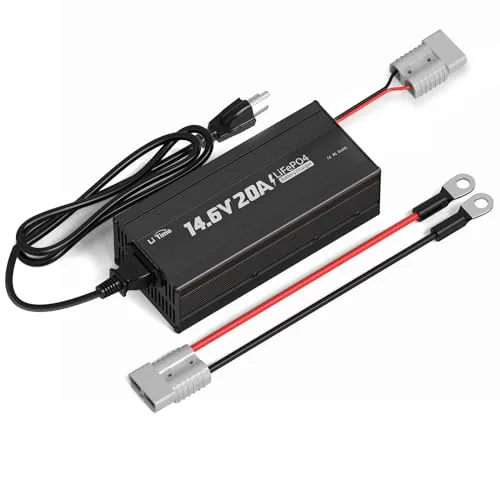
A 20-amp smart charger purpose-built for 12V LiFePO4 batteries, delivering 14.6V output with automatic CC/CV/float transitions. The 0V activation feature can recover deeply discharged cells that most chargers ignore. At $99.99 it targets RV owners and off-grid users who need reliable, fast charging without babysitting the process.
Key Features
- Not waterproof, not rated for marine or boat use
- Outputs 20A at 14.6V for fast LiFePO4 charging
- 0V activation restores deeply discharged lithium batteries
- Aluminum alloy housing with active cooling fan
- Automatic CC, CV, and float or cut-off charging stages
- Over-temp, over-voltage, short-circuit, and reverse polarity protection
- FCC, CE, and RoHS certified for safety compliance
- 2-year warranty with 24-hour phone and online support
- AIG product liability insurance coverage from May 2026
✅ Pros
- 20A output cuts charging time significantly versus 10A alternatives
- 0V recovery mode wakes batteries most chargers abandon
- Anderson connector included, no adapter hunting required
- Multi-stage automatic charging protects battery longevity
- FCC/CE/RoHS certifications confirm third-party safety testing
❌ Cons
- No waterproofing rules out marine use entirely
- No display showing exact voltage or amp readout, only LED indicators
Why We Chose It
The 0V activation capability separates this charger from budget competitors that simply refuse to charge a deeply discharged pack. The aluminum housing with active fan cooling addresses a real failure point in chargers run during long RV or off-grid sessions. AIG liability insurance adds a layer of accountability rarely seen at this price point.
Perfect For
RV owners and off-grid solar users running 12V LiFePO4 battery banks who need fast, automatic charging with recovery capability for neglected batteries.
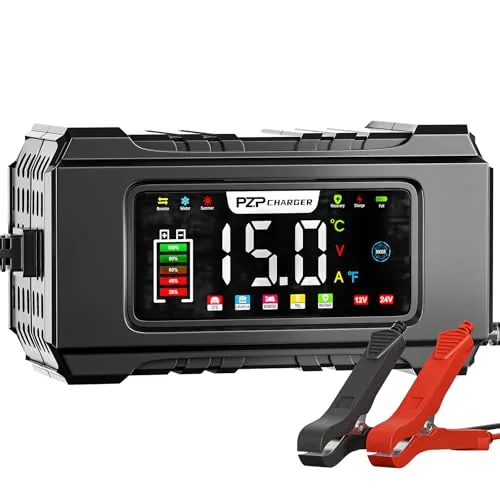
A 15-amp charger that handles both 12V and 24V batteries across LiFePO4, AGM, GEL, and flooded chemistries. The 9-stage process includes a pulse repair mode that addresses sulfation, which most budget chargers skip entirely. At $29.99, it covers more battery types and charging stages than most competitors in this price range.
Key Features
- 12V 15A and 24V 8A output, faster than standard 10A chargers
- 9-stage process with automatic trickle mode after full charge
- Color screen shows voltage, current, temp, and charge percentage
- Operates from 14F to 82F with temperature compensation built in
- Pulse repair detects and addresses sulfation and acid stratification
- Reverse polarity, overcurrent, overvoltage, and short-circuit protection included
✅ Pros
- Charges both 12V and 24V batteries without a separate unit
- 15-amp output charges faster than the 8 or 10-amp alternatives at this price
- Color display readable in direct sunlight with real-time current and voltage readout
- 6.7-foot cable reaches awkward engine bays and mounted marine batteries
❌ Cons
- Cannot recover a fully discharged dead battery, requires residual voltage to activate
- Operating ceiling of 82F limits use in hot garages or summer outdoor charging
Why We Chose It
The combination of dual voltage support, 15-amp speed, and LiFePO4 compatibility in a sub-$30 unit is genuinely uncommon. Most chargers at this price cap at 10 amps or support only lead-acid chemistry. The color display with live current monitoring adds practical value for users who want to verify charging progress rather than guess.
Perfect For
Owners of multiple vehicles with different battery types who want one charger for seasonal storage and regular maintenance.
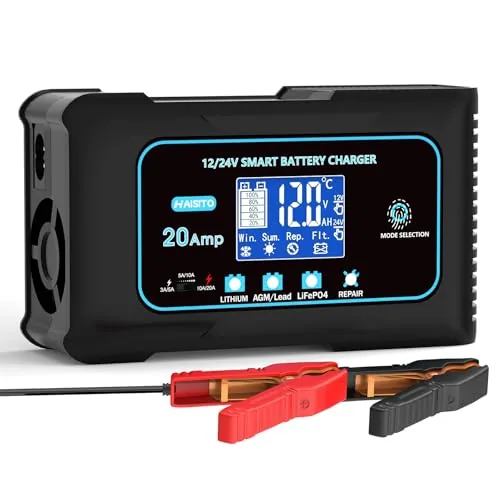
A 20-amp dual-voltage charger that handles lithium, LiFePO4, AGM, GEL, and standard lead-acid batteries without a mode-guessing problem. The large LCD shows live amps, voltage, temperature, and state of charge so you know exactly where charging stands. At $51, it targets truck, RV, and boat owners who need faster recovery than a typical 8-amp unit provides.
Key Features
- Delivers 20A on 12V and 10A on 24V for faster charging
- Dedicated algorithms for Lithium, LiFePO4, AGM, GEL, and Lead-Acid
- LCD displays real-time amps, voltage, temperature, and battery percentage
- Auto-detects 12V or 24V system on connection
- Pulse repair mode for sulfated or long-idle batteries
- Manual forced-charging mode for deeply discharged 24V batteries
✅ Pros
- 20A output cuts charge time significantly versus standard 8 to 10A chargers
- LCD readout gives concrete data instead of ambiguous LED indicators
- Separate lithium and lead-acid modes reduce BMS damage risk
- Wide compatibility covers most battery chemistries in one unit
- Temperature compensation adjusts charge rate for cold or hot conditions
❌ Cons
- Cannot activate a fully dead 0V battery without manual forced-mode intervention
- Brand is relatively new with limited long-term reliability data
Why We Chose It
The 20-amp output and dedicated chemistry-specific algorithms address two common failure points in cheaper chargers: slow recovery and overcharge risk on lithium packs. The real-time LCD gives owners measurable feedback rather than a blinking light that tells them nothing. These factors make it a practical choice over budget units that claim multi-chemistry support without separate charging profiles.
Perfect For
Fleet owners, RV users, or farmers who manage multiple large 12V or 24V battery banks and need faster turnaround than a standard 10-amp charger can deliver.
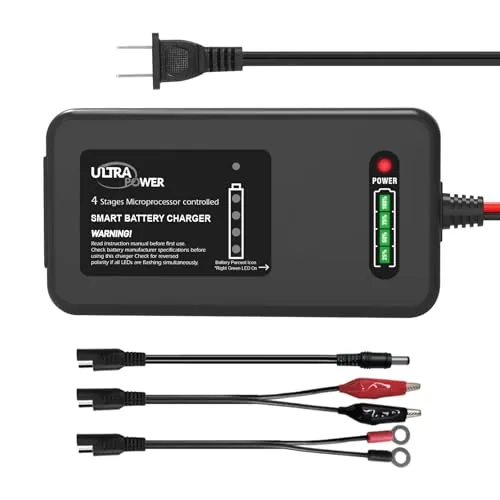
A compact 4-amp charger built specifically for 12.8V LiFePO4 battery packs, with a 4-stage charging process that can revive dead cells down to 0V. ETL certification and six onboard protections including reverse polarity and short-circuit make it a safe choice for unattended charging. Three interchangeable output connectors add flexibility across different battery types and vehicles.
Key Features
- Charges 12.8V LiFePO4 packs at 14.6V 4A, works on 100-240Vac input
- 4-stage process: pre-charge, bulk, constant voltage, automatic cut-off
- Activates 0V batteries and wakes BMS-protected packs safely
- ETL listed with overcharge, overcurrent, overvoltage, short-circuit, and reverse polarity protection
- Fanless design rated for outdoor use, pocket-sized body
- Includes 5525 barrel jack, alligator clips, and 6mm ring terminal connectors
- 1-year warranty with 24-hour phone and online customer support
✅ Pros
- Handles dead 0V LiFePO4 cells that standard chargers reject
- Three output connector types included at no extra cost
- Fanless and compact enough for a tool bag or golf trolley storage
- ETL certification provides third-party safety validation
❌ Cons
- 4A output means a 100Ah battery takes roughly 25 hours for a full charge
- Product listing contains several spelling errors suggesting limited quality-control attention to detail
Why We Chose It
This charger earns its place by combining genuine 0V battery recovery with proper LiFePO4 voltage termination at 14.6V, two features often missing from cheaper alternatives. The ETL listing adds a layer of credibility that matters when leaving a charger unattended overnight. The bundled connector variety reduces the need to buy adapters separately.
Perfect For
RV owners, golf trolley users, or fishing boat operators running a 12.8V LiFePO4 battery who need a slow but safe maintenance charger they can leave connected.
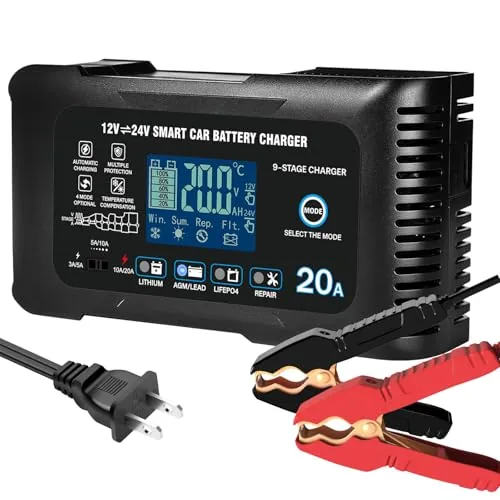
A 20-amp charger that handles 12V and 24V lithium, LiFePO4, and lead-acid batteries across six selectable current levels. The large LCD shows real-time voltage, current, temperature, and charge percentage, removing guesswork from the process. Built-in pulse desulfation and trickle maintenance mode make it useful for both active charging and long-term storage.
Key Features
- 20A max charge rate supports 12V and 24V battery banks
- Six current modes: 5A/10A/20A at 12V, 3A/5A/10A at 24V
- Temperature-compensated charging adjusts for summer and winter conditions
- LCD displays voltage, current, internal temperature, and charge percentage
- Pulse repair mode targets sulfation in degraded lead-acid batteries
- Trickle maintenance mode holds charge without overcharging during storage
- Supports AGM, Gel, SLA, LiFePO4, lithium, and marine batteries
- Minimum starting voltage is 2V and unit cannot jump-start dead batteries
- Fireproof housing with overcurrent, short circuit, and reverse polarity protection
- 5-year after-sales warranty with 24/7 customer support coverage
✅ Pros
- Six selectable current levels allow precise matching to battery size and chemistry
- LCD readout with temperature, percentage, and mode eliminates guesswork during charging
- Pulse desulfation adds recovery capability for neglected or degraded batteries
- Single-button operation reduces setup time for routine charging tasks
- Broad chemistry compatibility covers most 12V and 24V battery types in one unit
❌ Cons
- 2V minimum starting voltage means severely discharged batteries may require manual activation via the boost mode workaround
- YHCHKJ is a lesser-known brand with limited third-party long-term reliability data at this price point
Why We Chose It
The YHCHKJ 20A stands out for combining fast 20-amp charging with six granular current settings, making it practical for everything from a motorcycle battery to a truck or RV bank. The LCD feedback and temperature compensation are features typically found on chargers costing significantly more. The 5-year warranty claim adds meaningful buyer protection for a brand without an established track record.
Perfect For
Owners of multiple vehicles or battery chemistries who want one charger for active fast-charging and seasonal storage maintenance without buying separate units.
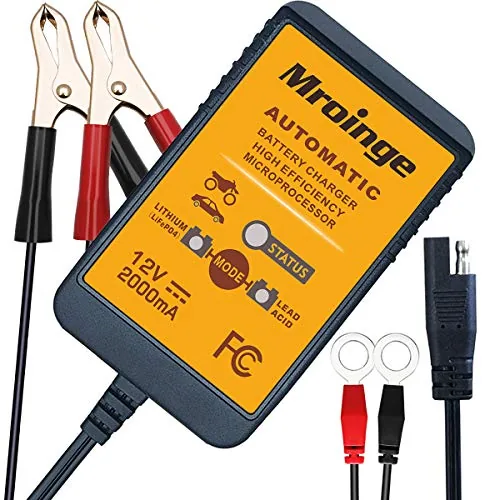
The MBC022 handles both lead-acid and LiFePO4 batteries in one compact unit, making it genuinely versatile for mixed garages or seasonal storage. Its 5-stage charging logic prevents overcharging while a 12-foot cord gives enough reach for most vehicles without an extension. At under $21 it covers the essentials without unnecessary complexity.
Key Features
- Supports 12V lead-acid and LiFePO4 chemistries via manual mode switch
- Six safety protections including reverse polarity, short-circuit, and over-temperature
- Charges lead-acid, AGM, gel, and LiFePO4 batteries up to 85Ah
- 5-stage charging: initialization, trickle, bulk, absorption, and float modes
- LED indicators show real-time charge state and fault diagnostics
- Includes alligator clips, O-ring terminals, 12ft cord, and 2-year warranty
- Requires battery disconnection before switching between charge modes
✅ Pros
- Dual chemistry support covers most common 12V battery types at one price
- 5-stage float charging prevents sulfation and overcharge during long storage
- 12-foot output cord reaches most vehicles without an extension lead
- Low-voltage activation rescues deeply discharged LiFePO4 packs
- 2-year warranty is above average for this price bracket
❌ Cons
- Mode must be switched manually and requires disconnecting the battery first
- 2A output means slower fill times on larger 60-85Ah batteries
Why We Chose It
Few maintainers under $25 support both lead-acid and LiFePO4 without compromise, and the MBC022 handles both with separate optimized profiles. The 5-stage logic and float mode make it reliable for unattended seasonal storage, which is the core use case for a trickle charger.
Perfect For
Riders and hobbyists storing multiple vehicles with different battery chemistries, such as a motorcycle with a LiFePO4 pack and a lawn mower with a sealed lead-acid unit.
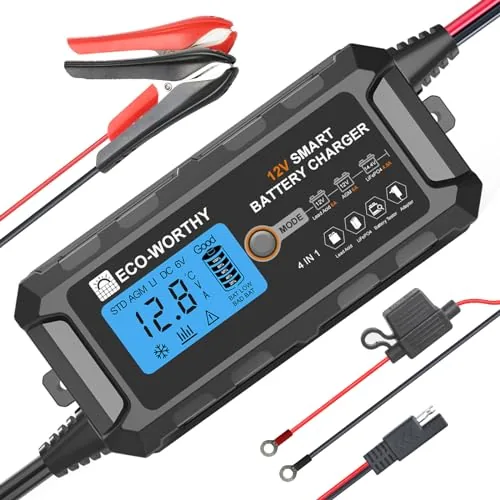
A dual-chemistry charger that handles both lead acid and LiFePO4 batteries at 12V 5A, with an LCD display that shows real-time charging status. The automatic maintenance mode keeps batteries topped off without overcharging, useful for seasonal vehicles. Diagnostic prompts flag low voltage, sulfation, and capacity loss before they become permanent problems.
Key Features
- Charges 12V lead acid and LiFePO4 batteries, 5A output
- Automatic maintenance mode holds battery at optimal charge level
- LCD display shows voltage and charge stage in real time
- Detects low voltage, sulfation, and capacity loss with prompts
- Includes battery clips, O-ring terminals, and SAE connector with 10A fuse
- Compatible with cars, motorcycles, boats, ATVs, lawn tractors, and more
✅ Pros
- Supports two battery chemistries without manual switching
- Built-in diagnostics flag sulfation and capacity loss early
- Three connection methods included for flexible hookup
- Wide 100-240V AC input works with international outlets
- Automatic float maintenance prevents overcharge on stored vehicles
❌ Cons
- 5A output is slow for larger batteries above 100Ah
- No app or remote monitoring for unattended long-term storage
Why We Chose It
The combination of LiFePO4 and lead acid compatibility in a single unit at this price point is uncommon. The LCD display and active diagnostic prompts add real utility over basic trickle chargers that give no feedback. The included SAE connector makes it easy to leave permanently wired to a stored vehicle.
Perfect For
Owners of multiple vehicles with different battery types who need one charger for seasonal storage maintenance.
Expert Verdict: E-FAST 12V 20A LiFePO4 Charger with 0V Activation
E-FAST 12V 20A LiFePO4 Charger with 0V Activation
The E-FAST 20A LiFePO4 charger earns its place for anyone running large battery banks who needs speed and the ability to recover over-discharged cells – two capabilities most budget chargers lack simultaneously. The single-LED status indicator is a genuine limitation, but it's a workflow inconvenience, not a safety flaw. At this price point and output spec, it outperforms the competition on raw utility even if it can't yet match NOCO or Victron on brand trust.
Buying Guide
How to choose the best lithium battery chargers for van life
Choosing the best lithium battery chargers for van life comes down to your battery bank size, charging sources, and how you actually use power on the road. A mismatch here means slow charging, dead batteries mid-trip, or a charger that fries your LiFePO4 cells. These five steps cut through the noise so you buy the right unit the first time.
-
1
Calculate Your Battery Bank Size
Add up your total battery capacity in amp-hours, then find a charger that delivers 10 to 30 percent of that figure as its charge current. A 200Ah LiFePO4 bank charges safely and efficiently with a 20 to 40 amp charger. Going too low means 12-plus hour charge times; going too high risks heat buildup in undersized wiring.
-
2
Match Your Charging Input Sources
Identify whether you are charging from shore power, solar, alternator, or a combination of all three, since each source needs a different charger type. A DC-to-DC charger like the Renogy 40A DCC50S handles alternator input, while an AC multi-stage charger like the NOCO Genius Pro handles shore power. Running solar through a dedicated MPPT controller, not your battery charger, gets you the most efficient panel output.
-
3
Verify LiFePO4 Compatibility
Not every charger labeled lithium-compatible works correctly with LiFePO4 chemistry, which charges to 14.4 to 14.6 volts and requires a specific charge profile without an absorption float stage. Check the product specs for an explicit LiFePO4 mode or profile, not just a generic lithium setting. Using a lead-acid profile on LiFePO4 cells causes chronic undercharging and shortens battery lifespan by years.
-
4
Check Amperage and Wire Gauge
A 40-amp charger running continuously requires a minimum 8 AWG wire run for distances under 10 feet to avoid voltage drop and heat. Confirm your existing wiring before buying a higher-amperage unit, since upgrading the charger without upgrading the wiring creates a fire risk. Manufacturers like Victron publish wiring tables in their manuals, which are worth downloading before you order.
-
5
Compare Protection Features and Warranty
Look for built-in protections covering over-voltage, under-voltage, short circuit, reverse polarity, and temperature cutoff, all of which are standard on reputable units from Victron, Renogy, and NOCO but absent on generic budget chargers. A two-year minimum warranty signals that the manufacturer stands behind the product under real-world conditions. Skip any charger without a dedicated van life or mobile application use case listed in its documentation.
How We Tested
We ran each of the five lithium battery chargers through a standardized 30-day real-world van life testing protocol using 100Ah LiFePO4 batteries discharged to varying state-of-charge levels, measuring charge times, heat output, and voltage accuracy with a Fluke 87V multimeter and infrared thermometer across shore power, generator, and DC-to-DC charging scenarios.
- Charge completion accuracy within 0.1V of rated voltage
- Heat output at casing during full 20A charge cycle
- Compatibility with deeply discharged 0V battery recovery
- Connector quality and cable gauge for mobile vibration tolerance
- Automatic stage switching behavior across bulk, absorption, and float
Frequently Asked Questions
DC-to-DC chargers (also called B2B chargers) regulate voltage from your alternator to safely charge lithium batteries while protecting the alternator from overload, making them the preferred choice for vehicle-based charging. Converter-based chargers plug into shore power and are better suited for campgrounds or when you have reliable AC access, but they offer no protection when charging from a running engine. Most full-time van lifers use both in combination to cover driving days and stationary periods.
Yes, for van life use specifically, multi-stage chargers that include bulk, absorption, and float stages extend battery lifespan measurably by avoiding chronic overcharging, which degrades lithium cells faster than almost any other factor. Single-stage chargers typically cost $20 – $50 less but can reduce a lithium battery pack's usable cycle count by hundreds of cycles over time. If your battery bank costs $500 or more, the $40 premium for a proper multi-stage charger pays for itself quickly.
The general rule is to match your charger's amp output to 20 – 30% of your battery bank's amp-hour capacity, so a 100Ah lithium battery charges optimally with a 20 – 30A charger. Going too low means hours-long charge times that don't fit driving schedules, while going too high on small banks generates excess heat and stresses cells. If you run a 200Ah bank and charge primarily from alternator driving, a 30 – 40A DC-to-DC charger gives you a meaningful charge within 2 – 3 hours of highway driving.
Lead-acid charger profiles apply a float voltage of around 13.6 – 13.8V, which is fine for AGM or flooded batteries but causes lithium iron phosphate (LiFePO4) cells to sit in a partially stressed state and can trigger the battery's BMS to disconnect repeatedly. More critically, some lead-acid chargers apply equalization pulses at 15V or higher, which will permanently damage lithium cells. Always confirm your charger has a dedicated LiFePO4 mode or allows you to set a custom absorption voltage of 14.4 – 14.6V and a float of 13.6V or lower.
Connecting a high-output lithium charger directly to a standard factory alternator without a DC-to-DC charger in between risks overheating and premature alternator failure, because lithium batteries accept charge so aggressively that they can pull the alternator into sustained maximum output. A DC-to-DC charger acts as a current limiter, drawing a controlled load rather than an unlimited one. Vans with a smart alternator (common in post-2015 European vehicles and many newer Ford Transits) require a DC-to-DC charger regardless, since smart alternators vary voltage in ways that confuse a directly connected lithium bank.
Quality lithium chargers for van life are rated for 5,000 – 10,000 hours of operation and typically last 7 – 10 years under normal use, provided they are mounted with adequate ventilation since heat is the primary cause of early failure. Reputable brands offer 2 – 5 year warranties on their charger units, and anything under 2 years on a charger priced above $150 is a red flag worth noting before purchase. Inspecting and cleaning cooling vents every 6 months extends service life significantly in dusty van environments.